ShareAs a private tour guide in Israel, I take my clients to such places as the Old City of Jerusalem, Masada and the Dead Sea, Galilee and its beautiful lake (the Sea of Galilee) and the Negev Desert in the south. I recommend places to stay such as the King David Hotel in Jerusalem, the […]

As a private tour guide in Israel, I take my clients to such places as the Old City of Jerusalem, Masada and the Dead Sea, Galilee and its beautiful lake (the Sea of Galilee) and the Negev Desert in the south.

I recommend places to stay such as the King David Hotel in Jerusalem, the Scots Hotel in Tiberias and the new Beresheet Hotel in Mitzpe Ramon. True, these hotels are not suited to everyone’s budget, so I have to be able to suggest alternative places to stay while still demanding customer satisfaction – no easy thing.

The same goes for where to eat. Eating in a foreign country should be one of the most enjoyable things one does. How many times have I heard, “I’m on vacation. I’ll go back on my diet when I get home.” I know I say it!

A good tour guide should know where to go to eat.

Here are a few steadfast rules:
1. Don’t go where you see lots of tour buses. Mediocre food, high prices and spotty service will be the norm. Be careful of restaurants that only cater to foreign tourists. That goes for any country.
2. Does the staff speak English? This is not a problem in Israel. Even the smallest falafel stand will be able to communicate with you, but be wary.
3. Does the establishment have menus in English?
4. Does the establishment take credit cards?
5. Finally, my acid test: how clean are the restrooms.

Now, I know that there are exceptions to the rules. For instance, the best restaurant in the Jewish Quarter in Jerusalem, the “Cardo Café,” caters almost exclusively to foreign tourists, but is quite good (they also have the cleanest restrooms in the Middle East)!

So, in the next few installments, I will recommend some eateries that I frequent.

    ShareWhat to Wear: Part 3 As a private tour guide in Israel, I adhere to a dress code laid out by the Israel Tour Guides’ Association of which I am an active member. We (men) wear shirts with collars and sleeves (no t-shirts), long-legged pants (no shorts) and closed shoes (no sandals). In this way, […]

    What to Wear: Part 3

    As a private tour guide in Israel, I adhere to a dress code laid out by the Israel Tour Guides’ Association of which I am an active member.

    We (men) wear shirts with collars and sleeves (no t-shirts), long-legged pants (no shorts) and closed shoes (no sandals).

    In this way, we try to present ourselves in a professional manner to our clients.  Bear in mind that we also tour in holy places.

    It pains me when I see tour guides wearing shorts in places like the Old City of Jerusalem.  In this way, they can offend all three great monotheistic religions at the same time!

    But, enough about me; how should you dress when coming to Israel?

    For men, I think that wearing shorts is generally a bad idea.  A light pair of pants available from outfitters such as Columbia, North Face or Mountain Hardwear are perfect for the climate here (remember, it is hot and sunny most of the year, here in Israel and you really need protection from those harmful ultra-violet (UV) rays).  Shirts that have a collar and sleeves.  Long-sleeve shirts are actually a good idea as they will protect your arm from the sun!

    For women, I recommend a light shirt with a collar and sleeves that almost reach the elbow light pants or skirt that cover the knees.  Conversely, a light blouse or T-shirt can be worn and a light scarf can be used to cover your shoulders and arms.  Most women do not cover their heads in churches or synagogues unless they feel they have to.

    As we become more aware of the harmful effects of the sun’s rays on our skin and the long-range issues that are involved, I really do recommend going on-line to a tour outfitter and purchasing some items that will protect you on your trip not only here, but anywhere where the weather is hot and sunny.

    See you soon!


      ShareMany prospective visitors to the Holy Land ask me what special item(s) of clothing should I bring. In my last blog, I wrote about the importance about what shoes to bring (and what to leave at home). Now, with the summer beginning, I think it is time I talk about how to keep safe in […]

      My new Tilley hat!

      My new Tilley hat!

      Many prospective visitors to the Holy Land ask me what special item(s) of clothing should I bring.

      In my last blog, I wrote about the importance about what shoes to bring (and what to leave at home).

      Now, with the summer beginning, I think it is time I talk about how to keep safe in the sun.  That means wearing a good hat made to

      1. Keep you cool
      2. Filter out the harmful ultra-violet (UV) rays of the sun
      3. Make you look good

      As a private tour guide in Israel, I have gone through quite a few of them: Barmah of Australia makes great hats, but they are made out of kangaroo hide and get very hot in summer.  Companies like North Face, Columbia and others make good hats for touring outside.

      Here are some tips:

      1. Does the hat have a UV filter rating?
      2. If it does, is it at least a 50?
      3. Does the hat have a string to secure it to your head in windy weather (believe me, you will not be chasing hats off of the top of Masada)?
      4. Does is have a guarantee?
      5. Does it cover the back of your head and neck?

      What not to wear:

      I strongly advise not to wear ball caps.  Though that White Sox cap does look good on Obama, it won’t do you much good on a hot, sunny day in the Old City of Jerusalem.

      Don’t wear a kefiyyah (traditional Arab headdress).  You are not a Bedouin.  This can sometimes be interpreted as a political statement.  Quite frankly, we have enough political statements, thank you very much.

      A scarf will not keep out those bad UV rays.

      Is there a perfect hat?  I think there is: A Tilley hat.

      You an purchase one at: www.tilley.com

      It has a lifetime guarantee and they will replace it if you lose it.


        ShareThough an itinerary, tailor-made for the family or individuals I tour with in Israel, constitutes a very important component of any tour, little things can make or break a great trip. Take shoes, for instance. Most Americans love wearing running shoes or sneakers when they tour.  Good for running, those New Balance or Nikes were […]

        Though an itinerary, tailor-made for the family or individuals I tour with in Israel, constitutes a very important component of any tour, little things can make or break a great trip.

        Take shoes, for instance.

        Most Americans love wearing running shoes or sneakers when they tour.  Good for running, those New Balance or Nikes were made for running on a flat, level surface.  In Israel, you might be walking on the uneven stones of the Old City of Jerusalem, or hiking up the very gravelly  “Snake Path” up to the top of Masada!  You need good hiking, not running shoes.  Both New Balance and Nike do make a sturdy hiking shoe.  So do other companies like Merrill, Vasque and a host of others.

        However, you are not only going to be walking around cities and parks.  Most of my clients spend at least one day at the Dead Sea.  Others walk the “wet tunnel” or Hezekiah’s Tunnel, a twenty-seven hundred year old archaeological marvel at the bottom of the City of David National Park.  You can’t wear hiking shoes; you will ruin them.  Do not wear beach clogs unless you are on the beach in Tel Aviv.

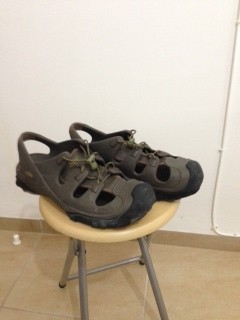
        So what should you wear in the wet?  How about a pair of waterproof Keens or Crocs pictured below?

        crocs private tour guide in israel

        Some will say, “I don’t need a pair of these, I’ll just pack on old pair of gym shoes.”

        I say do get a pair of Keens or Crocs.  You will use them at home in summer.

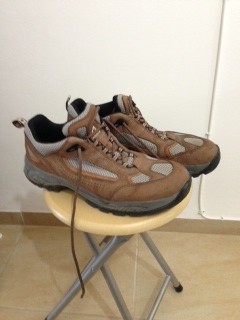
        As for a general shoe to walk around in Israel, I own a pair of Vasque hiking shoes with Vibram soles.  They are strong, well-made and support the foot.

        hikers private tour guide in israel

        Of course, adventure sandals can be substituted for the Keens and/or Crocs.  Source, Tevas and Chacos.

        My next blog will be about hats.